
Thesis of the Year Awards Were Presented at the University Consortium Day Celebration
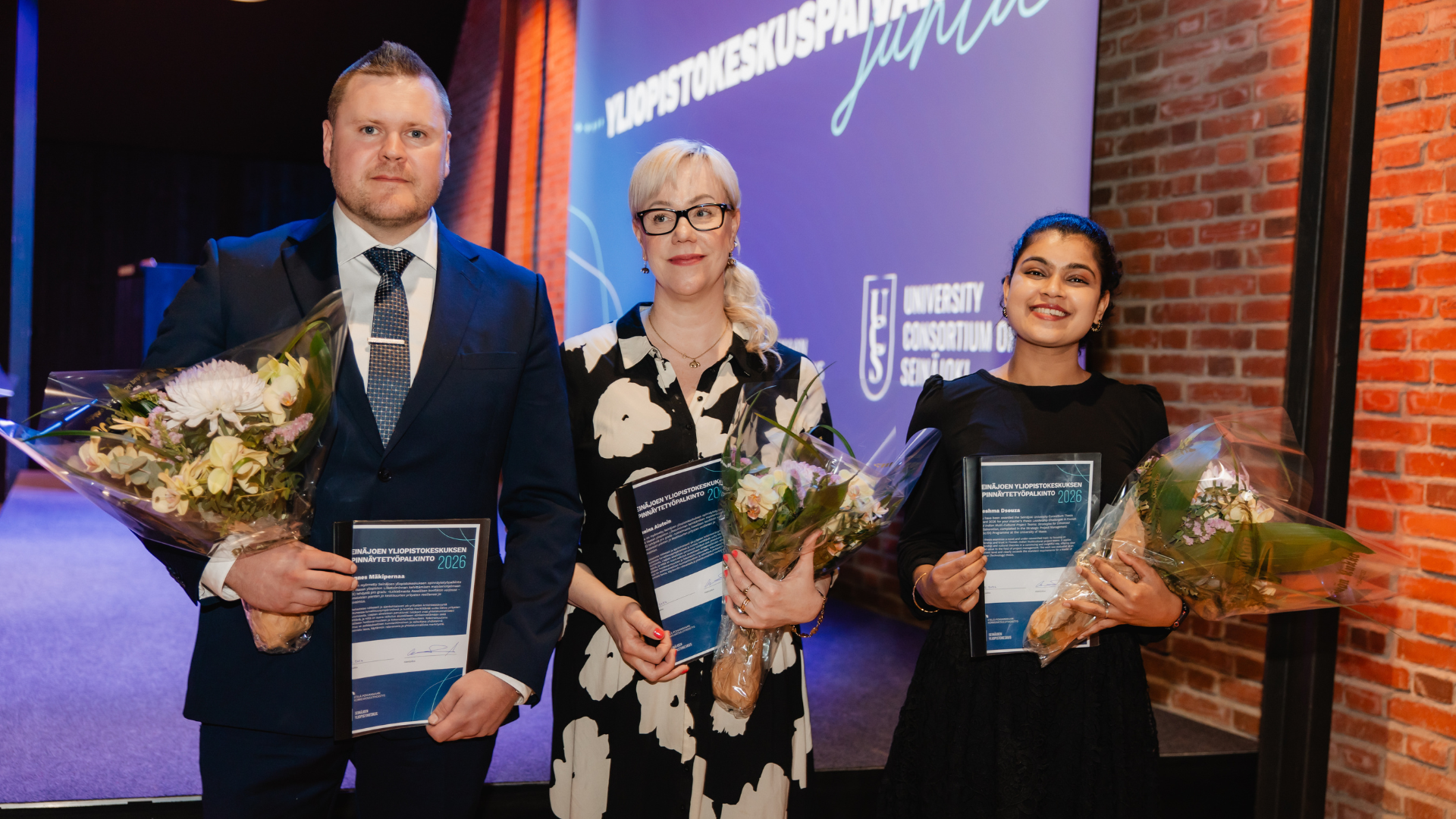
University Consortium of Seinäjoki’s annual thesis awards were presented at the University Consortium Day celebration in Kalevan Navetta on Monday, 4 May. The purpose of the thesis awards is to highlight the distinguished theses completed within the Consortium’s degree programmes and to recognize their authors.
This year, three theses were awarded: a bachelor’s thesis, a master’s thesis in technology, and a post-graduation thesis. The recipients were Emmi Kaasalainen, Reshma Dsouza, and Annina Alutoin & Hannes Mäkipernaa.
Reshma Dsouza
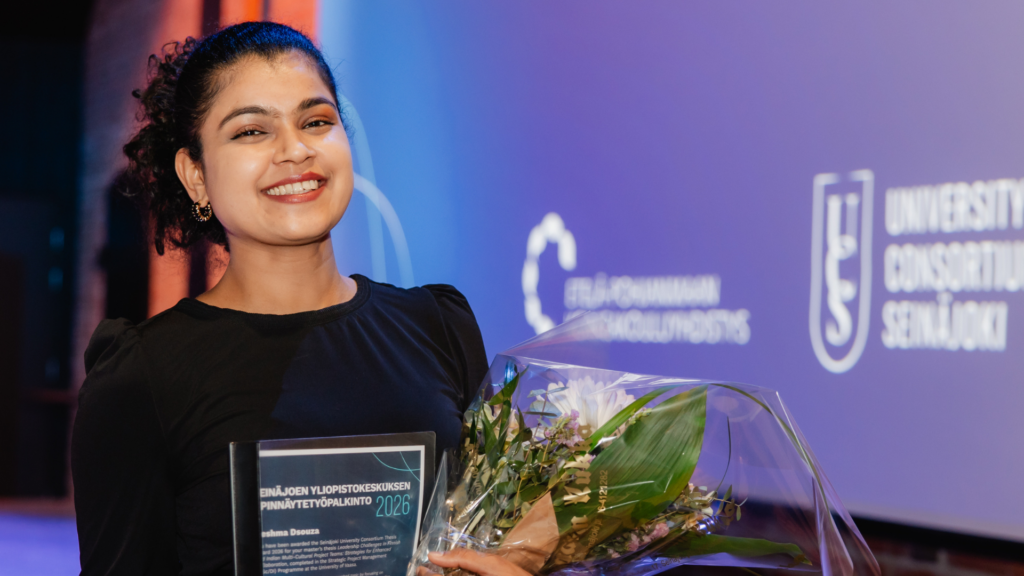
For Reshma, the award represents a significant moment within a broader research trajectory. Her work, which focuses on Leadership Challenges in Finnish and Indian Multi-Cultural Project Teams: Strategies for Enhanced Collaboration, has contributed to ongoing scholarly discussions on Intercultural Communication and Project Management. In the interview that follows, Reshma reflects on the development of her research, the methodological and conceptual challenges encountered along the way, and the broader significance of the findings that led to this recognition.
We began the interview with an introduction to Reshma and her thesis. Reshma Dsouza has over 10 years of project management experience in different countries such as Kuwait, Dubai and India. She has been living in Finland since 2023 and is dedicated to mastering the Finnish language. She pursued her master’s in Strategic Project Management in University of Vaasa and also gained experience as a teaching assistant. She worked on a project with University of Applied Science in Seinäjoki (SeAMK), where she contributed her ideas, applied her research knowledge to help make advancements towards achieving the goal of retaining foreign talents in Finland, furthering discussion on how the Finnish employers could enable better integration of foreign resources. Her research is based on different theories and the challenges that leaders face in multicultural teams. She has conducted in-depth surveys to get a better
understanding of the employees in multicultural team, employees in all levels of positions such as product managers, professors, consultants, research scientists and so on. Based on the survey results, she has also built strategies to be included in the thesis, which would help teams overcome some difficulties that they usually face. The research currently has a gap as her thesis was only focused on two cultures, i.e. Finnish and Indian, but using the same principle, it can be broadened to include other cultures and studied. While her research only focused on employees who were working onsite, there is further research gap for resources who are working in hybrid modes or completely remotely.
Since Reshma has worked with multiple multicultural teams, she has worked with people from over 20 nationalities people. She had always been curious as to why people are so different from each other. While it is obvious that it is due to differences in cultures, she wanted to dig deeper and learn more about it. This was a clear motivation for her to conduct this research and share the knowledge she has gained from her own experience and from the research with others. As a project manager, she has seen the different types of communications and ways of working, which was eye-opening for her. Furthermore, she saw that many people were aware of the differences but couldn’t understand why there was such a big difference. The research gap that she noticed was that the available literature always focused on a huge number of countries and never a direct comparison between a small set of countries, so she narrowed it down to India and Finland and focus on the cultural and communication style comparison of these 2 cultures.
This led to further discussion on the conceptual obstacles that she faced when conducting her research. For Reshma, the biggest obstacle was collecting the data as it was scattered, and the literature review was specifically challenging as not a lot of research has been done on this topic. She had a structured way of approaching it and attempted to understand the various aspects of intercultural interaction one by one. She approached communication first, followed by culture, equality, adaptability and inclusion. These elements, combined with Transformational Leadership Theory, Schwartz’s Cultural Value Theory, Social Identity Theory, and adaptive leadership strategies, summed up her focus for this research. All these theories highlighted multiple cultures where she narrowed them down to just the two cultures she wanted to focus on.
Now that we had discussed her thesis, the conversation naturally flowed towards the impact her thesis had. She says that initially she had no idea that her thesis would affect so many people but now she sees that with the rise of internationalisation and growth in multicultural teams, many organizations have taken a deep interest in the topic. When she shared her research results with such organizations, she received highly positive feedback. Leaders have started focusing on adapting to the changing environments. While she had not expected winning an award, she is glad that she did the research which has helped as many people and will continue to do so in the future. She hopes for an opportunity to continue her research with the same foundation, go further in-depth and even cover other cultures.
From her research, Reshma learned to think more critically about her topic and approach it empathetically. She put herself in the shoes of the participants and used her own experience as a manager to further improve her research. We closed the interview with understanding what Reshma hopes the audience would take away from her thesis. She says that if the readers could learn one thing from her research, she hopes that it would be to realise that each communication and work style has its pros and cons, and if such differences are approached with an open mind, it could lead to a more inclusive and productive environment.
Justifications:
The research objective was to determine the differences in leadership expectations, communication norms, and trust mechanisms among Finnish and Indian project team members. This is very interesting topic since there is almost no research done regarding multicultural project teams with specific cultural combinations. The theoretical framework combines key leadership and cultural theories, yet research on how leadership styles and cultural adaptability interact in Finnish–Indian project teams, as well as on how trust is built between these two cultures, remains very limited. A clear and well‑written research report.
Article: Roshni Gurnani
Photos: Taina Renkola
Read Emmi Kaasalainen’s and Annina Alutoin & Hannes Mäkipernaa’s interview here!